





The Ultimate Guide to LED Par Can Lights
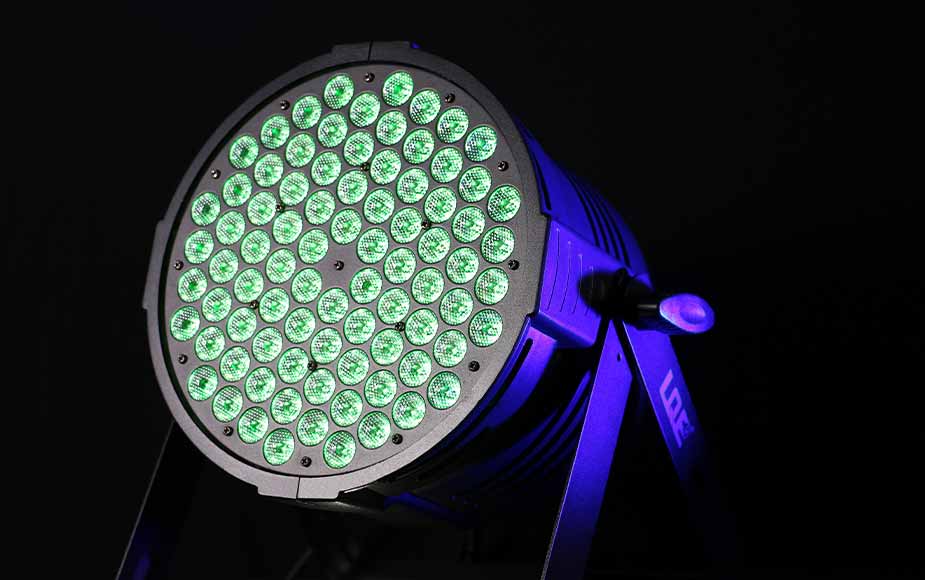
Par can lights are a relatively common stage light. They are popular in churches, stages, theaters, clubs and art performance groups because they are cheap and lightweight.
Additionally, you can find them in convention halls, auditoriums, galleries, and studios. Even stadiums often opt for par lights to reduce costs without compromising lighting quality.
Color Imagination offers a wide range of LED par lights at affordable prices. Check out this guide to get a better understanding of par lights.
What Is Par Can Light?
The term PAR (parabolic aluminized reflector) refers to the visible part of a sealed beam lamp. Par cans are utilized on stages for back, accent, wash, and area lighting, among other directed lighting options. Their light beams are regulated to provide exact lighting.
A par light is a sealed beam lamp that combines a light source, reflector, and lens into one unit. There are several beam spreads that can be achieved with a single direction of light concentration from the lamp’s reflector, including wide flood, medium flood, narrow spot, and very narrow spot. The traditional par can light is a hollow cylinder housing a par lamp socket. It lacks zoom and focus capabilities.
Why Do Par Can Lights Use LED?
The most energy-efficient and rapidly developing kind of lighting technology at present is light-emitting diodes (LEDs). Considering all of its benefits, LEDs are frequently the greatest option for par lights. Here is a detailed introduction to their benefits:
First, because of their small size, LEDs are highly adaptable and have a wide range of lighting applications. They can create a range of colors of light despite their small size. White light, for instance, can be created by combining red, green, and blue LEDs.
Second, there is no longer a need for diffusers and reflectors that trap light because LEDs only emit light in certain directions. In many applications, including task lighting and recessed downlights, this characteristic increases the efficiency of LEDs. Furthermore, the LED structure is much more resistant to brittleness because an epoxy lens is employed in place of glass.
Heat dissipation is the main concern with any lighting solution, although LEDs don’t produce a lot of heat. In contrast, 80% of the energy in a CFL and 90% of the energy in an incandescent lightbulb is transformed into heat. Furthermore, compared to other light sources like fluorescent or mercury vapor lamps, LED lighting does not pose the same environmental risks.
Lastly, compared to conventional lighting items, LED lighting products usually have a longer lifespan. Superior LED bulbs have a lifespan of thirty times longer than incandescent bulbs and three to five times longer than CFLs. LEDs have a minimum lifespan of 50,000 to 100,000 hours on average.
Main Features of LED Par Can Lights
LED par can lights come with a range of features that make them a versatile and energy-efficient lighting option. Below we introduce some of their main features:
Color Changing
The color-changing capability of RGB LED par can lights has made them very popular. An LED par light can have a single-color system or a multi-channel (white/color-changeable) light.
A single-color luminaire can be powered by a wide variety of LED kinds. Discrete packages are used in the construction of multi-channel LED systems. InGaN emitters are used to pump phosphors into white LED device packages, also known as phosphor-converted packages.
Warm white and cool white LEDs are used to create tunable white lights, which offer an ever-changing spectrum of color temperatures. In addition to the three LED primaries (red, green, and blue), full-color systems typically incorporate extra hues, such lime, white, and/or amber, to broaden the color spectrum.
Moving Head
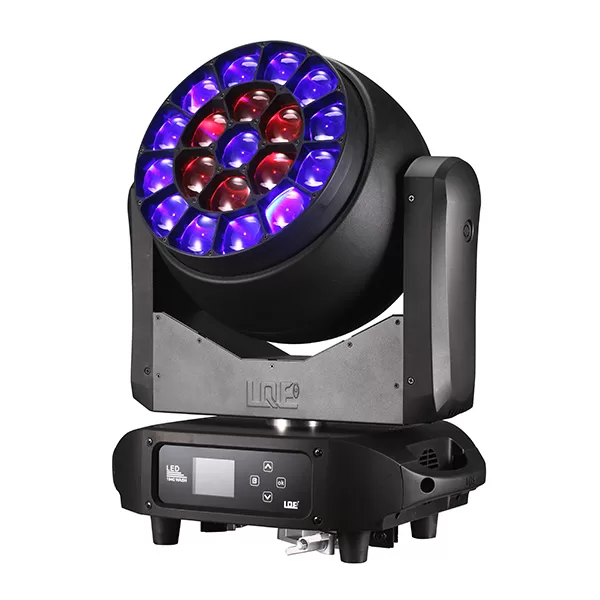
An additional feature of an LED par can light is its moveable head. The head can be focused, zoomed, tilted, and dimmed. The goal of the numerous, adjustable LED par lights with moving heads is to replace the usual, stationary lights.
They can quickly alter several of their optics’ characteristics, altering the personality of the light, with the right programming. Lighting is often pre-programmed and controlled with straightforward commands, however, moving heads can be “live” controlled with sufficient experience.
IP-Rated LED Par Light
The abbreviation for “Ingress Protection” is “IP.” It is a means of determining how well a material will shield an object from liquids and solids such as sand, dust, and dirt. The IP rating is two-digit. The first number indicates protection against solid objects, and the second number indicates protection against liquids.
IP40-rated LED par lights are usually seen in closed setups or indoor stages. An IP40 LED par light should not be used outside until the fixture is closed. It normally works out flawlessly for indoor events, unless there are extreme weather conditions, such as high humidity.
Complete dust protection is provided with LED par light rated IP54. It merely protects against water splashing for liquids. Furthermore, IP64 LED par lights offer decent defense against hard objects. The LED light cannot possibly be impacted by any solid particles. But the LED par light only acts as a barrier against water splashing.
IP65-rated LED par lights are perfect for both public and private occasions. Complete protection against water jets and foreign objects is provided by the IP65 rating. Water ejected through a 6.3mm nozzle wouldn’t damage an LED par light.
IP67-certified LED par lights provide total protection from water and sediment. Similar to IP65 and IP64, they offer the same level of liquid protection. But LED par lights bearing this certification are much more waterproof.
That being said, LED lights with this grade have far more water resistance. Even when submerged in water up to a depth of one meter, the LED par lights remain unaffected by the water.
Sound Activated
The term “Sound Activated” describes how the light will respond to the bottom rhythm in the music by turning on its internal effect algorithms. The DMX communication protocol is used to control lighting with an external DMX controller. Every sound-activated light has a microphone built-in.
The function of a microphone is to identify sound waves in the immediate area and convert them into an electrical signal. The sound-activated light is designed to change the color and position of its LEDs in response to sounds detected by an inbuilt microphone. The result is a light that reacts to noises in its surroundings.
Smart Control
LED par lights can be controlled using a specific mobile application. This makes it simple to control the lights and can be accessed from anywhere.
The direct DMX control of LED lights avoids the need for additional dimmers, as the electronics of the luminaires can adjust the brightness of the LED, which is one of their main advantages. Due to its low power consumption, many devices can be connected to a single power supply.
The DMX protocol can be used to control the majority of moving head LED par lights. To do this, professionally insulated twisted pair cables with 5-pin XLR connectors on both ends are typically used. Every fixture has a DMX channel block assigned to it at a DMX universe site.
Beam Width
Stage lighting depends as much on the geometry of the parabolic reflection as it does on the diameter of the par can. The light can form a huge or small spot depending on the angle. They traverse both vast stretches of floodwater and little spaces at angles ranging from 12 to 70.
The par light can create a range of beams, from a narrow speck to a vast flood, depending on the geometry of the parabolic reflector, the filament arrangement, and its position within the paraboloid. Furthermore, par lights are made to provide a certain beam mode, either high beam or par.
Conclusion
In short, LED par can lights are widely used in the lighting industry because of their excellent performance, and can be used for a variety of indoor and outdoor stages, activities, etc. It is advisable to choose LQE® if you’re looking to buy LED par lights for your business’s lighting needs. This way, you can get LED par cans in large quantities at a reasonable price.
1000w
Do You Supply After-Sale Service?
LQE lighting offers 7x24 hrs systematic SOP customer support with dedicated personnel, ensuring quick and comprehensive assistance for stage lighting needs.
Can I Have a Sample Order for an LED DJ Light?
Sure, sample order are welcome to test and check LQE quality. Mixed samples are acceptable.
What Kind of Certificates You Offer?
All kinds of certificates could be offered by LQE digital moving light factory, which depends on customer’s required, different pricing plan for different approval.
What Is the Warranty Offered by LQE Lighting?
LQE lighting offers a comprehensive 1-year warranty and spare parts on its products, giving customers peace of mind and investment protection.
Distributor
What types of companies can become LQE distributors?
We welcome partnerships with companies that have experience in the entertainment, AV, lighting, or stage equipment industries. Whether you are a local reseller, importer, system integrator, or project contractor, we are open to exploring win-win cooperation.
Want to learn more information?
[Reach out to us and receive professional guidance, a personalized quote, and the best solution for your needs.]
LQE is a professional LED stage lighting manufacturer, focusing on OEM/ODM and high-end customization.
◼ Contact LQE
Email: kyle@lqelighting.com
WhatsApp: +86 180 2413 9579
Address: No. 8 Road Liguan, Guanyao, Nanhai District, Foshan, China.
Linkedin
YouTube
Whatsapp: +8618924548390
TikTok